+1 647 637 9108
 +1 917 477 8991
 +91 93281 27044


 +61 3 9013 3988

Fantasy sports apps at first were just online games. Today, they have turned into fully fledged online platforms.
There are lots of different functions, such as live sports data, user interactions, payment systems, and legal requirements that they have to deal with. So, for entrepreneurs and the business team, there is one question that comes up very soon. How much does it cost to develop fantasy sports mobile app, really, from the idea to the launch?
A fantasy sports app development cost is not only an expense. It tells what the product is, the technology used, the team that you will be working with, and the coming of the app.
The article explains the cost to develop a fantasy sports app. We will be discussing the development stages, major cost drivers, and regional factors. It is intended to help both business leaders and technical teams agree on the correct cost, effort, and trade-offs.
Components and Features of a Fantasy Sports App
Before you figure out how much it will cost to create a fantasy sports mobile app, it’s very important that you first understand the makeup and the features of a fantasy sports app.
Generally, a fantasy sports app is one where a user can create a virtual team of players, score points according to actual players’ performances in the match, and then participate in a competition or league.
The app is bifurcated into two modules: Admin Panel and User Panel. Both modules feature an essential set of functionalities that significantly impact their development complexity.
Admin Panel Features
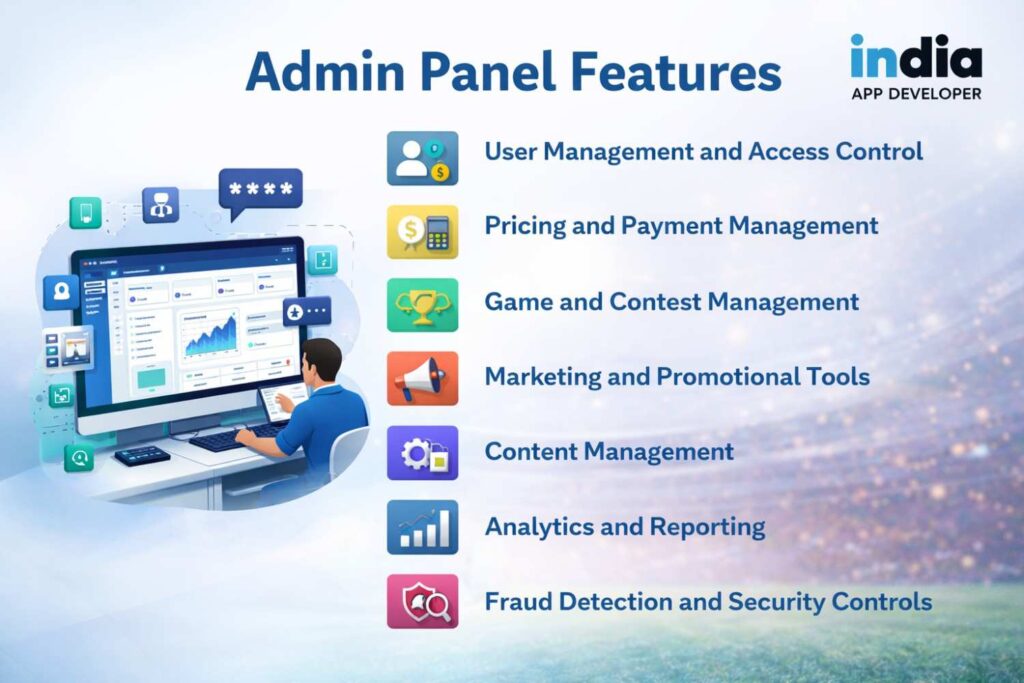
User Management and Access Control: Admins possess the capability to create new users, delete existing users and block users from accessing the system, while they can distribute different roles to users along with their associated access rights.
Pricing and Payment Management: Establish entrance charges for events, manage financial distributions, and monitor digital currency storage for users.
Game and Contest Management: Design, timetable, and administer contests or leagues across various sports.
Marketing and Promotional Tools: Use campaigns, notifications, and referral programs for user engagement.
Content Management: Share match updates together with tips and news and in-app content. Analytics and Reporting: Understand users’ behavior, measure contests’ performance, and track revenue for business decisions.
Fraud Detection and Security Controls: Identify suspicious activities, take measures against cheating and guarantee secure transaction processes.
User Panel Features
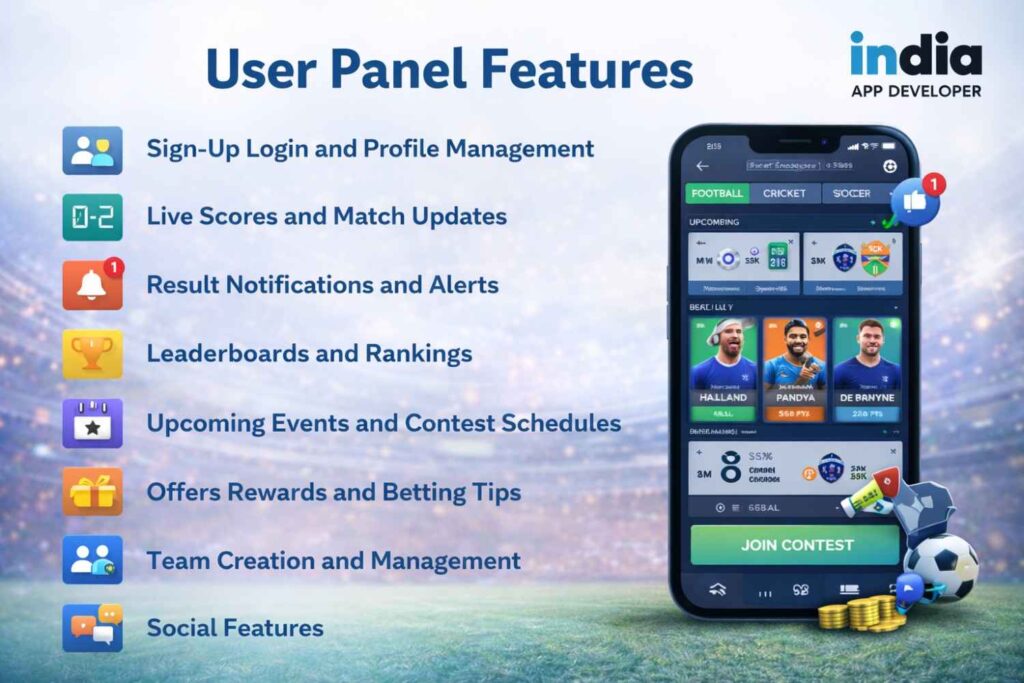
Sign-Up Login and Profile Management: The system enables users to create their accounts while also allowing them to access their accounts and modify their personal information through safe methods.
Live Scores and Match Updates: The system provides users with current match data which helps them make better choices.
Result Notifications and Alerts: The system notifies users about their contest outcomes while showing updates to leaderboard standings and match times.
Leaderboards and Rankings: The system displays user achievements through multiple contests and all league events, which lets users see their current standing.
Upcoming Events and Contest Schedules: The system shows users upcoming matches together with their scheduled starting times to keep them engaged with the platform.
Offers Rewards and Betting Tips: The system displays marketing materials together with customer loyalty incentives and betting strategies for users to access.
Team Creation and Management: The system provides users with tools to build their fantasy teams which they can then modify and use to create winning strategies.
Social Features: The system provides users with chat functions together with sharing options and referral systems, which help build a stronger community.
The process of defining admin and user roles through their respective functions helps stakeholders and development teams to estimate upcoming features and determine the development costs for the fantasy sports application.
The development of an application becomes more difficult when the application contains advanced features, which include analytical tools, fraud detection systems, and social networking capabilities.
A minimum viable product (MVP) with basic features may cost between $25,000 and $45,000, while an advanced feature-rich app can range from $60,000 to $150,000 or more, depending on its complexity. Companies need to incorporate this additional complexity into their financial budget and project development schedule.

Factors Influencing Fantasy Sports App Development Cost
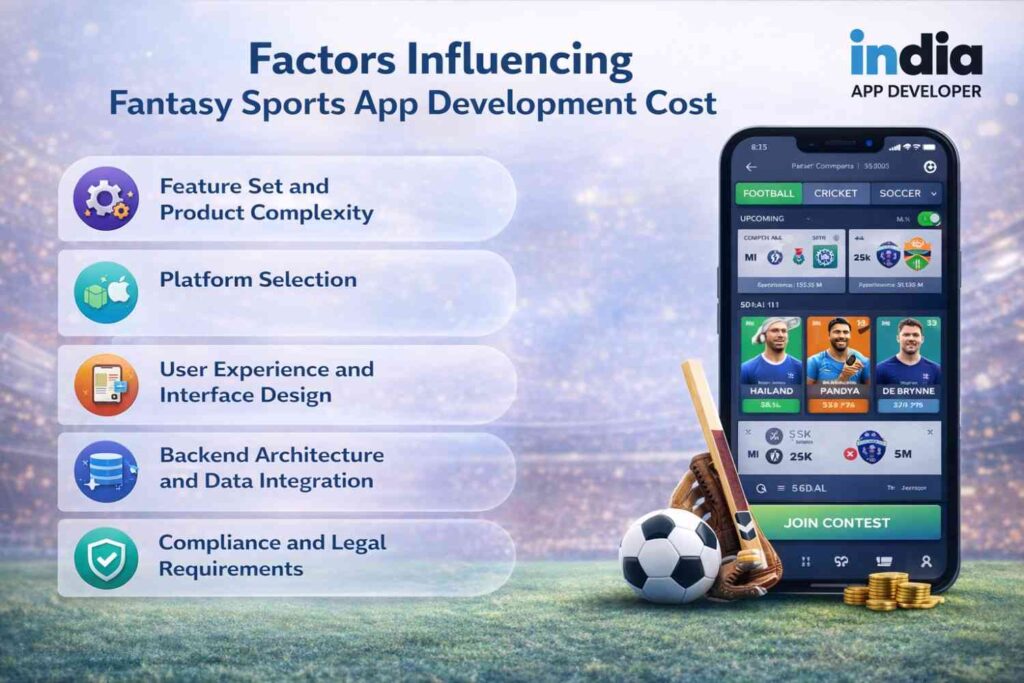
Fantasy sports app development cost depends on five main factors, which include the selected platform, design requirements, backend system needs, and legal obligations. The development cost of a fantasy sports application increases when additional features are added, multiple platforms are supported, real-time data is required, & compliance needs to be met.
Feature Set and Product Complexity
The main factor behind the cost to develop a fantasy sports app is feature scope. A basic app focused on one sport with simple contests costs less. A platform that supports many sports, advanced stats, and social features costs more.
Core features usually include team creation, scoring rules, and contest entry. Advanced features may include private leagues, referral systems, and in-app messaging. Some platforms add premium tools like AI-based suggestions or support for multiple currencies.
As features grow, so do development time, testing needs, and ongoing maintenance.
2. Platform Selection
Choosing where the app will run affects cost. Building for iOS and Android separately needs two codebases. This increases development and testing effort. Cross-platform tools can lower early costs but may limit performance or real-time features.
Many startups release on one platform first. They expand later once they see user traction and feedback.
3. User Experience and Interface Design
Fantasy sports apps depend on speed and clarity. Users make quick decisions during live matches. If the interface is confusing, users leave.
Design costs include research, wireframes, visual layouts, and usability testing across devices. Design work may seem secondary, but clear interfaces reduce support issues and improve retention over time.
4. Backend Architecture and Data Integration
The backend handles scoring logic, contest validation, and transactions. It must process live data without delays.
Costs here depend on server setup, scaling plans, and integration with sports data providers. Security is also critical, especially for payments and personal data. These areas are core to trust and compliance. They are not optional savings.
5. Compliance and Legal Requirements
Fantasy sports apps operate under different rules depending on the region. Some markets require age checks or responsible gaming tools. Payment handling must follow financial regulations.
These requirements add cost through extra features, documentation, and review cycles. They often affect timelines as well.
Development Phases and Cost Distribution
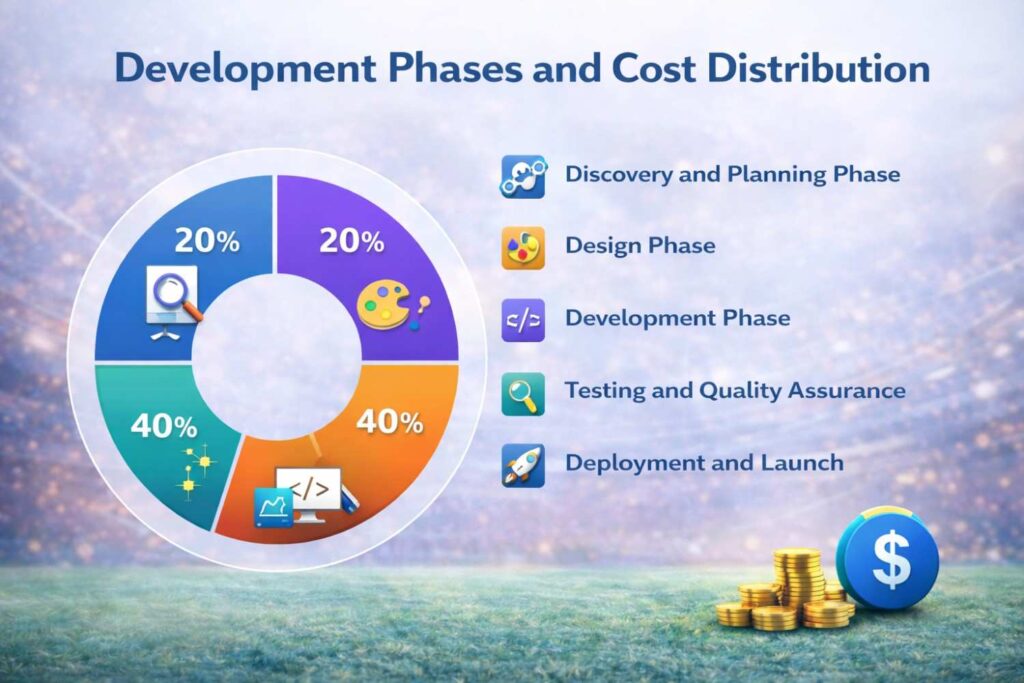
Development cost is spread across planning, design, development, testing, and launch. Early planning and design shape the budget, while development takes the largest share. Testing and launch add final costs to ensure stability, security, and a smooth release.
Discovery and Planning Phase
This phase defines what will be built and how. Teams review market needs, list features, and plan the technical structure. This stage helps prevent scope changes later.
While the cost here is smaller, it has a strong impact on the total project cost.
2. Design Phase
Design turns requirements into screens and user flows. Cost depends on how custom the experience is and how many user paths exist.
Good documentation from this phase helps business and development teams stay aligned.
3. Development Phase
This is where most of the cost to develop fantasy sports app is spent. It covers frontend screens, backend logic, data connections, and third-party services.
Costs vary based on feature depth, code quality standards, and team experience. Many companies look to a mobile app development company in India at this stage. The region offers skilled teams at a lower cost compared to many Western markets.
4. Testing and Quality Assurance
Testing checks that features work, data updates correctly, and payments are secure. Fantasy sports apps need strong testing because of live data and financial risk.
Skipping testing often leads to higher costs after launch and damage to user trust.
5. Deployment and Launch
Launch includes app store submissions, server setup, and monitoring tools. This phase is short but needs close coordination between teams.
Regional Cost Considerations and Development in India
The app development cost for a fantasy sports platform varies significantly across regions due to labor rates, infrastructure, and local expertise. India is often chosen by global companies because of its lower development costs and a mature technology services sector.
Many businesses work with app developers India for their experience in building scalable fantasy sports apps.
The advantages of working with Indiappdeveloper include two main benefits, which are access to skilled developers and flexible engagement models that include dedicated developer hiring options along with cost structures that enable phased development and scaling.
The development partner selection process requires both cost assessment and assessment of three other factors, which include project management capabilities and protection of intellectual property.
Approximate Regional Cost Ranges for Fantasy Sports Apps
| Region | MVP (Basic Features) | Advanced App (Full Features) |
| India | $15,000 – $25,000 | $40,000 – $90,000 |
| United States | $40,000 – $80,000 | $100,000 – $200,000 |
| Europe | $30,000 – $70,000 | $80,000 – $160,000 |
| Other Asia-Pacific | $15,000 – $35,000 | $50,000 – $100,000 |
The approximate ranges depend on the number of sports supported, real-time data integration, wallet and payment systems, and the complexity of the admin panel and existing regulatory requirements.
The partnership with app developers India delivers cost savings for our project while maintaining high-quality results and enabling us to expand and sustain our application throughout its lifecycle.
Cost Ranges and Variables
The development costs of a fantasy sports application cannot be determined through a single price point. The costs increase based on the selected features, the chosen technological solutions, the chosen platforms, and the necessary operational functions. Stakeholders can use the understanding of these variables to create their budgets while making strategic decisions.
Key variables that influence cost include
- The number of sports supported
- The costs charged by real-time data providers
- The expenses linked to the payment gateway implementation
- The requirements for the admin panel development and the content management system operations
- The expenses linked to maintenance activities, system updates, and security measures
The expenses of development work differ according to the application design and the multiplayer feature requirements. The following section presents an estimated cost distribution for various kinds of fantasy sports applications.
App Type | Description | Approximate Cost Range (USD) |
Simple App | Single-sport, basic team creation, scoring, and leaderboard | $10,000 – $20,000 |
MVP App | Core features for one or two sports, wallet integration, and notifications | $20,000 – $35,000 |
Advanced App | Multi-sport support, private leagues, referral programs, analytics, social features | $40,000 – $90,000 |
AI-Based App | Predictive analytics, AI-driven player recommendations, dynamic scoring, and advanced personalization | $100,000 – $150,000+ |
Development time, testing requirements, and maintenance needs increase with each additional step of complexity. AI-based applications require both sophisticated backend systems and the ability to create data models and process information in real time.
Advanced applications that support multiple sports require strong server systems and instant updates and complete administrative management functions.
Decision-makers can use these ranges to match their budget needs with expected system features and company growth plans. Hire dedicated developers because this approach will help them control costs while delivering high-quality work, which can grow and meet legal requirements.
Startup vs. Expansion Development Decisions
One key decision is whether to build everything upfront or start small and scale later. A phased approach often lowers risk. It allows teams to learn from user behavior before adding features.
In many practical cases, successful platforms begin with a focused product. They invest more after launch based on usage and performance data.
Why Choose IndiaAppDeveloper for Your Fantasy Sports App Development
The process of selecting a development partner for fantasy sports platforms requires organizations to examine multiple factors beyond development expenses. The assessment requires evaluation of the developer’s technical skills, their expertise in the specific industry, and their capacity to provide ongoing support after product delivery.
IndiaAppDeveloper develops fantasy sports applications that maintain consistent performance, secure infrastructure, and predictable development schedules, making them suitable for both initial projects and growing applications.
Key reasons organizations work with IndiaAppDeveloper include
1. Fantasy sports development expertise:
The company has developed expertise in live scoring engines, contest and league management systems, payment processing solutions, and admin panel workflows, which help them to implement projects with minimized risk and rework.
2. Balanced cost and quality approach:
The development team uses feature prioritization and technical efficiency methods for their planning process, which lets businesses control their fantasy sports application development expenses while retaining essential system functions.
3. Scalable and reliable architecture:
The backend systems are built to handle increased user activity during live matches and during periods of user growth, and when new features are added.
4. Flexible engagement options:
Companies have the option to employ dedicated developers who will assist them in developing their minimal viable product, enhancing their features, and maintaining their system according to their evolving needs.
5. Security and compliance readiness:
The organization implements strong data protection measures, transaction security protocols, and access control systems to fulfill both regional and platform protection requirements.
6. Structured delivery and communication:
The project team establishes project goals through clear documentation and milestone creation and maintains project alignment through ongoing communication with their stakeholders.
Conclusion
The cost to develop fantasy sports mobile app depends on technical complexity, business goals, and regional choices. Each phase from planning to launch adds its own cost drivers.
For non-technical stakeholders, understanding these elements helps in setting realistic budgets and vendor discussions. For technical leaders, aligning architecture and features with cost limits supports steady growth.
Fantasy sports app development cost is not a single figure. It is a structured investment across phases, features, and long-term operations. Careful evaluation at each step helps teams move from idea to launch with control and clarity.