+1 647 637 9108
 +1 917 477 8991
 +91 93281 27044


 +61 3 9013 3988
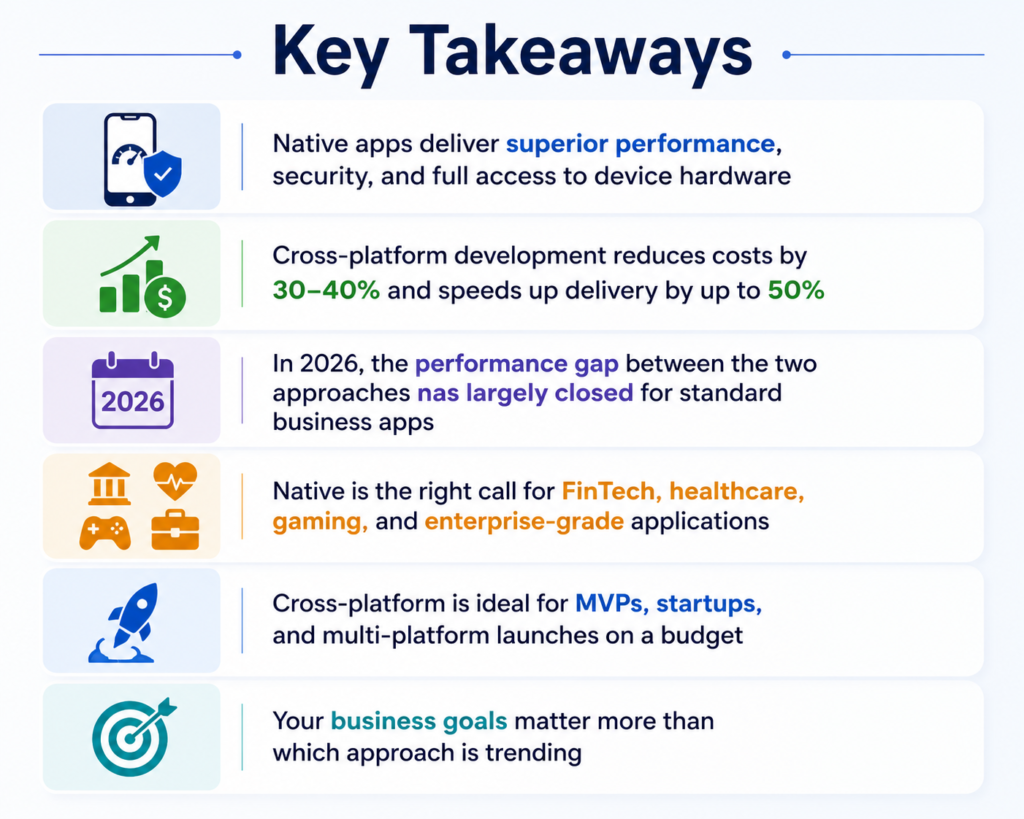
In simple words, Native apps are built separately for Android and iOS using Swift and Kotlin. Cross-platform apps use a single shared codebase, built with tools like Flutter or React Native, to run on both platforms at once, reducing development costs by 30-40% and cutting time-to-market in half. The right choice depends on your app’s complexity, budget, and speed-to-launch goals.
Quick Comparison: Native vs. Cross-platform
| Factor | Native Apps | Cross-platform Apps |
| Performance | Excellent | Good to Very Good |
| Development Cost | Higher | 30-40% lower |
| Time to Market | Longer | Up to 50% faster |
| User Experience | Superior | Moderate to Excellent |
| Platform Support | Separate Codebases | Single codebase |
| Maintenance | Higher effort | Easier, unified updates |
| Scalability | Best for complex apps | Best for MVPs & startups |
| Offline Capability | Excellent | Good |
| Device Feature Access | Full | Limited in some cases |
| AI/ML Integration | Easier | More complex |
What Is Native App Development?
Native app development means building an application specifically for one operating system. If you want an iOS app, your developers write it in Swift or SwiftUI (Apple’s language). For Android, they use Kotlin or Jetpack Compose. These are two separate apps, two separate teams, two separate codebases.
How Native Apps Work
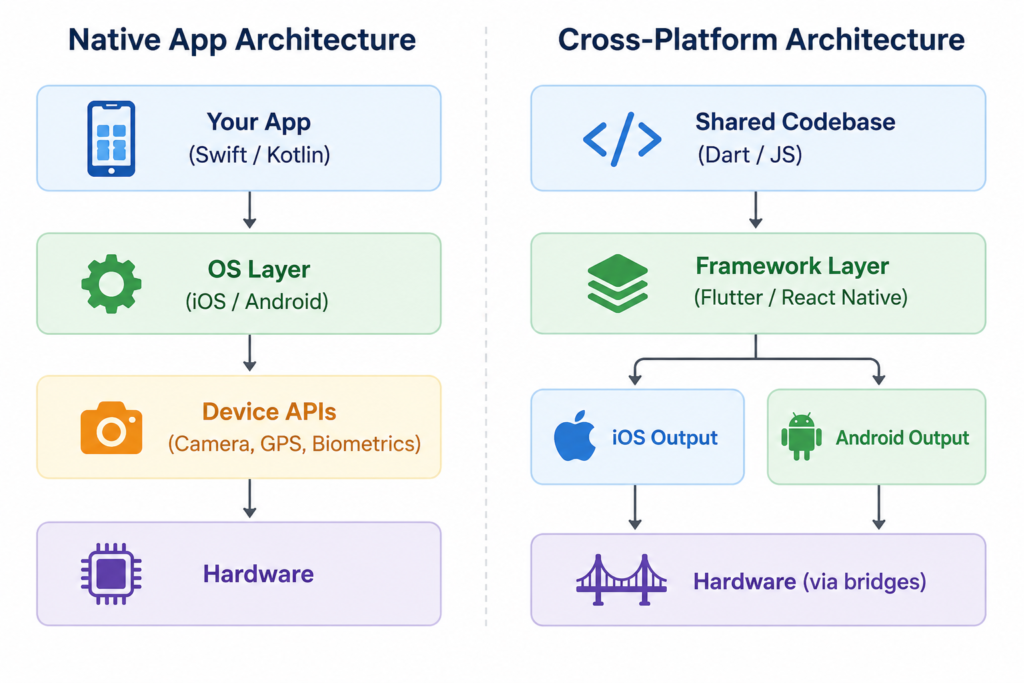
Native apps communicate directly with the operating system. There are no middlemen, no translation layers. When a native iOS app needs to access your camera or biometric sensor, it talks to Apple’s APIs directly. That is why native apps typically have faster load times, smoother animations, and better battery usage.
Architectures
What Is Cross-platform App Development?
Cross-platform development lets you write one set of code that runs on both iOS and Android. Frameworks like Flutter, React Native, and .NET MAUI handle the translation between your single codebase and each platform’s native output.
A leading cross-platform app development company India, like IndiaAppDeveloper, typically works in Flutter or React Native to build apps that launch simultaneously on iOS and Android, saving you from running two parallel development tracks.
How Cross-platform Frameworks Work
Modern cross-platform tools have come a long way. Flutter compiles Dart code directly into native ARM machine code, so it doesn’t rely on a JavaScript bridge like older tools did. React Native’s new architecture (called Fabric) has eliminated the slowdowns that used to give cross-platform a bad reputation. In 2026, for the majority of business applications, users cannot tell the difference.
The Key Differences: Native vs Cross-platform
| Criteria | Native Apps | Cross-platform Apps |
| Speed | Fastest | Slightly slower (gap nearly closed in 2026) |
| UI Consistency | Platform-perfect | Shared UI (near-native with Flutter) |
| Security | Highest | Good |
| Development Cost | Expensive (two teams) | Cost-efficient (one team) |
| Maintenance | Separate updates per platform | Unified updates |
| Scalability | Excellent for large apps | Moderate; depends on complexity |
| Battery Optimization | Better | Framework-dependent |
| Graphics / Rendering | Best | Very good (Flutter’s impeller engine) |
| Hardware Access | Full access | Partial limitations on some sensors |
| AI / ML Integration | Easier | More complex |
(1) Which Offers Better Performance?
Native apps still win when raw speed is mission-critical; think real-time AR filters, on-device machine learning, or complex 3D animations. That said, the gap for typical business applications has effectively closed in 2026.
Flutter’s Impeller rendering engine now delivers consistent 60-120 FPS. React Native’s new architecture has removed the old bottlenecks that caused slow animations. For a standard e-commerce app, a logistics dashboard, or a SaaS tool, users will feel no difference between a well-built cross-platform app and a native one.
(2) Which Is More Cost-Effective?
Cross-platform wins here by a significant margin. Building native means hiring two separate development teams (one for iOS and one for Android), doubling your QA effort, and maintaining two codebases indefinitely.
Cross-platform removes all of that redundancy. Teams using Flutter or React Native report 30-40% lower development costs and development cycles that are 30-40% faster. For a $200,000 native project, the equivalent cross-platform build often comes in at $120,000 to $140,000.
(3) Which Is Easier to Maintain?
Cross-platform has a clear advantage. One-time bug fixing, one-time update, one-time deployment, and it’s done for both iOS and Android simultaneously. Native maintenance means writing the same fix twice, running two QA cycles, and coordinating two App Store submissions.
Over a couple of years, this hidden cost compounds significantly. If keeping ongoing maintenance costs low matters to your business, cross-platform is the sensible choice.
(4) Which Provides Better User Experience?
Native apps feel exactly like the platform they were built for. iOS apps follow Apple’s Human Interface Guidelines by default. Android apps follow Material Design patterns. The result is an experience that feels deeply familiar to each platform’s users.
Cross-platform apps have historically struggled here, but modern Flutter apps are largely indistinguishable from native for everyday users. The experience difference is now mostly relevant for highly design-sensitive products like premium consumer apps or brand launch experiences.
(5) Which Is Better for Scalability?
Native is better for large, complex applications that need to scale to millions of users and integrate deep hardware capabilities. Cross-platform scales well for most business use cases but can hit limitations when advanced device features, like continuous Bluetooth in the background, custom camera pipelines, or IoT sensor communication, are involved. If your three-year roadmap involves heavy integrations, plan for natives from the start.
(6) Which Is More Secure?
Native apps have a security advantage because they operate closer to the operating system and have direct access to platform-level encryption, biometric authentication, and secure domains.
Cross-platform apps are secure for the vast majority of applications, but the additional framework layer creates a marginally larger attack surface. For banking, healthcare, and government applications, native development is the industry standard for exactly this reason.
When Should Your Business Choose Native Apps?
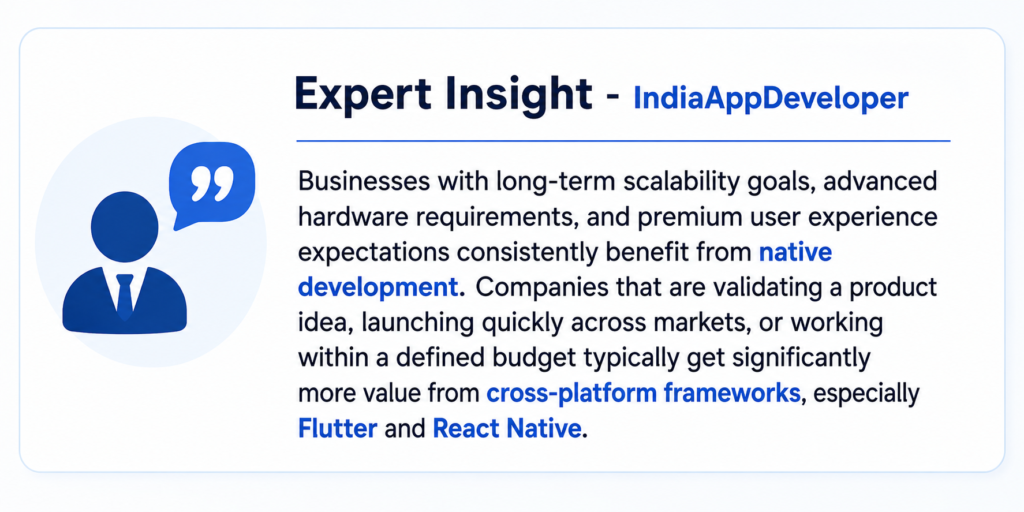
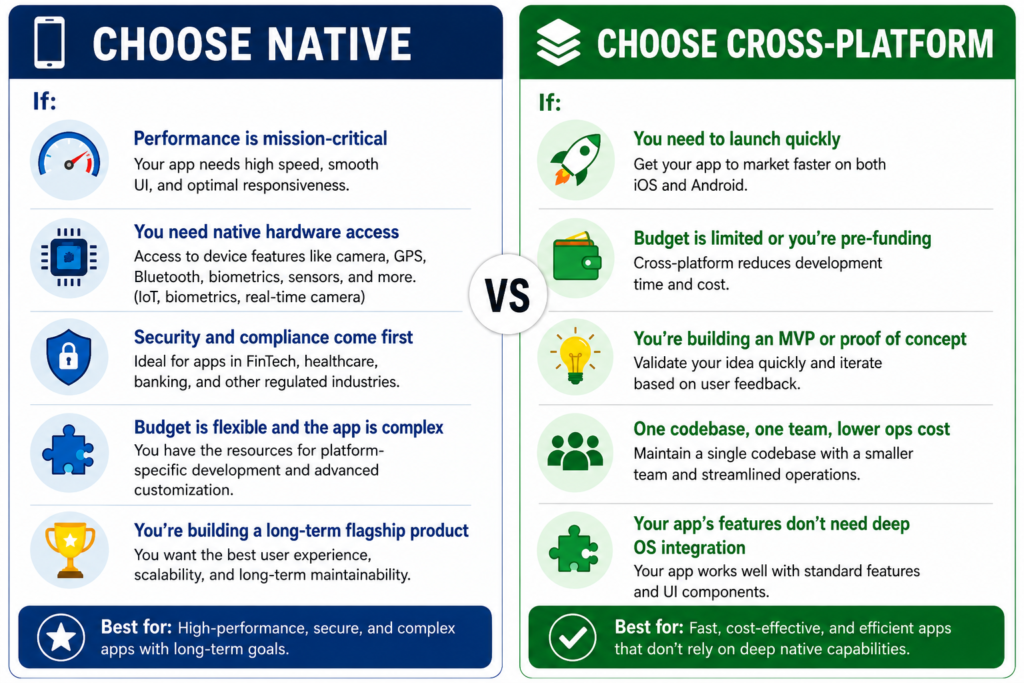
Native development is worth the higher upfront investment when the wrong app experience would directly cost you customers, compliance, or competitive advantage. Here are the scenarios where native is the right call:
- FinTech and banking apps: Security compliance, real-time transactions, and biometric authentication
- Healthcare platforms: Sensitive patient data, regulatory requirements (HIPAA), and device integrations
- Enterprise mobility solutions: Large organizations with complex workflows and security policies
- Gaming applications: High-performance rendering, continuous animation, and real-time physics
- Streaming services: Adaptive bitrate, DRM, and hardware-accelerated video decoding
- IoT Ecosystems: Continuous background execution and direct Bluetooth/hardware communication
| Industry | Recommended Approach | Primary Reason |
| Banking & FinTech | Native | Security compliance and transaction integrity |
| Healthcare | Native | Sensitive data handling and regulatory requirements |
| Gaming | Native | Graphics performance and real-time rendering |
| Streaming / Media | Native | Hardware-accelerated video and DRM |
| E-commerce | Cross-platform | Faster rollout and lower build cost |
| SaaS Startups | Cross-platform | Budget efficiency and speed to market |
| Logistics & Ops | Cross-platform | Operational tools that need broad reach |
| Social Media | Native | Feed performance, notifications, and camera |
When Should Your Business Choose Cross-Platform Apps?
Cross-platform mobile application development India is increasingly the first choice for companies that need to move quickly, manage costs, and still deliver a quality experience on both iOS and Android. Cross-platform makes the most sense in these situations:
- MVP development: Validate your product idea without committing to full native budgets
- Startups Launches: Reach iOS and Android users simultaneously from day one
- Budget-conscious Businesses: One codebase, one team, one maintenance cycle
- Faster market testing: Deploy, learn, and iterate in weeks rather than months
- Internal enterprise tools: Field ops apps, dashboards, and productivity tools where UI perfection is less critical than function.
Native vs Cross-Platform: Cost Comparison
| Development Phase | Native | Cross-Platform |
| UI/UX Design | Higher (two design systems) | Moderate (shared design) |
| Frontend Development | Two separate teams | One shared team |
| Backed Integration | Similar | Similar |
| Testing & QA | Two test suites | Unified test suite |
| App Store Submission | Two separate processes | Two (but once for both platforms) |
| Ongoing Maintenance | Higher (two codebases) | Lower (one codebase) |
| Estimated Total Cost | $120,000 to $300,000 or more | $70,000 to $180,000 or more |
Which Approach Is Better for Startups?
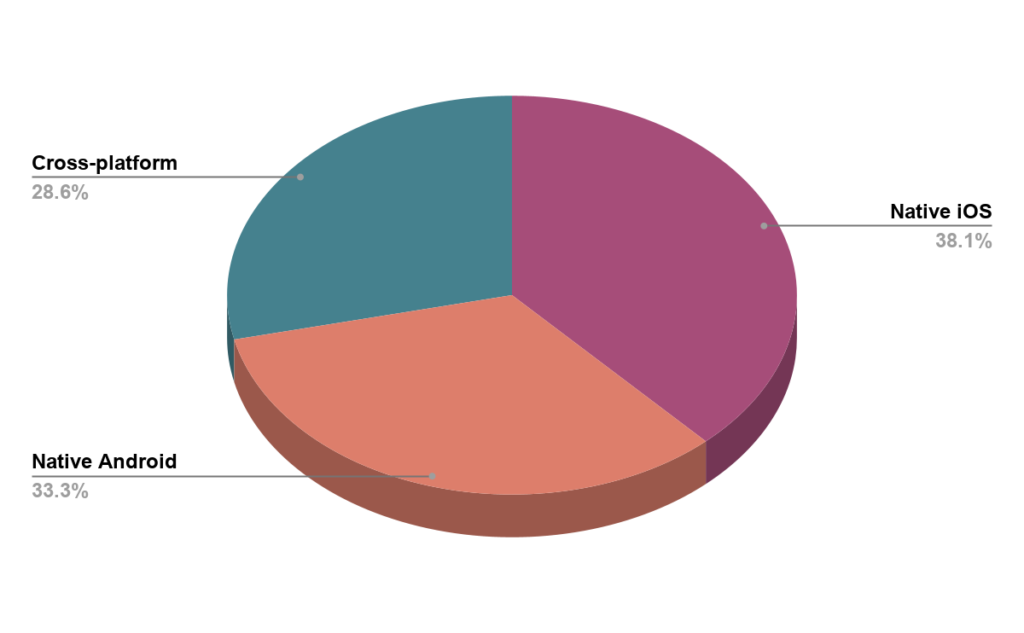
For most startups, the answer is cross-platform, but not because native is not good. It is because speed and budget are your scarcest resources at the early stage.
Here is what the numbers look like for a typical startup scenario. A cross-platform MVP can be built, tested, and submitted to both app stores in 3-4 months. The equivalent native build for both platforms typically takes 6 to 9 months and costs 40-60% more. That is the difference between delivering before or after your funding runway runs dry.
Instagram, Discord, and Shopify all use cross-platform frameworks in development. The risk profile has shifted from ‘experimental’ to ‘proven,’ and working with a React Native development company India or a Flutter app development company in India means you get the same production-grade quality at a fraction of what a US-based team would charge.
Popular Technologies Used in 2026
| Technology | Type | Best For | 2026 Status |
| Swift / SwiftUI | Native iOS | Premium iOS apps, Apple ecosystem | Industry standard |
| Kotlin / Jetpack Compose | Native Android | Android-first apps, Google ecosystem | Industry standard |
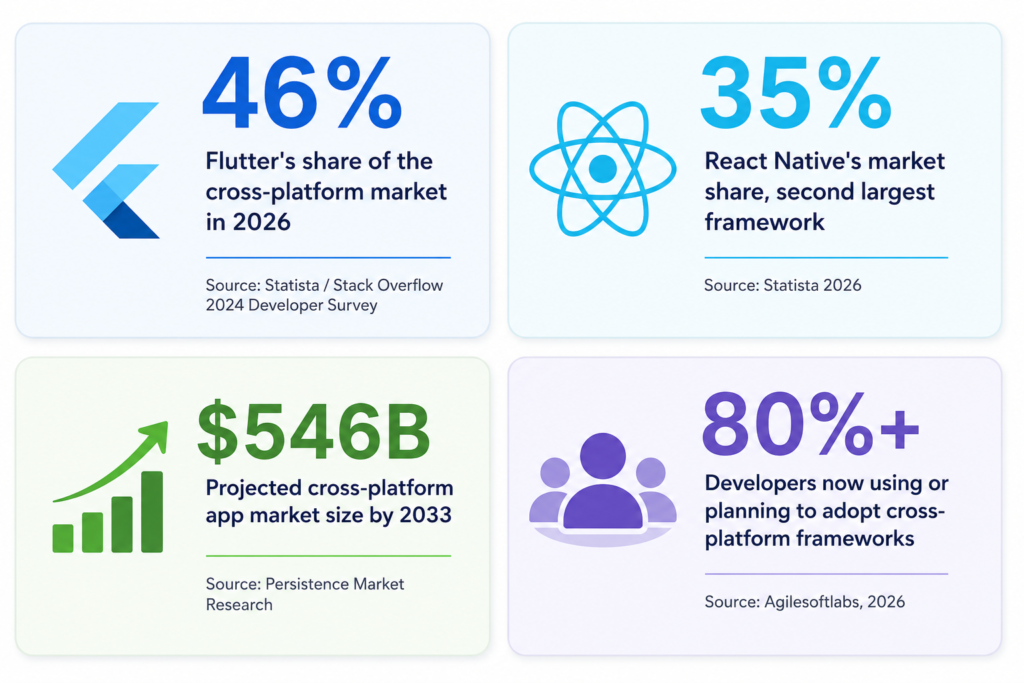
| Flutter | Cross-platform | Fast, UI-rich apps, startups, MVPs | 46% market share, dominant |
| React Native | Cross-platform | JavaScript teams, startups, MVPs | 35% market share, mature |
| .NET MAUI | Cross-platform | Enterprise apps, Microsoft ecosystem | Growing adoption |
| Kotlin Multiplatform | Cross-platform | Shared business logic, native UI | Emerging, credible |
If you are considering cross-platform mobile application development India, the two frameworks to evaluate first are Flutter and React Native. Flutter leads in market share (46%) and delivers flawless UI consistency. React Native benefits from the massive JavaScript developer ecosystem and is often the faster choice for teams already working in JavaScript.
Companies that hire Flutter developers India typically do so for applications where consistent visual branding across platforms matters; Flutter’s own rendering engine means the app looks exactly the same on iOS and Android. Companies that hire React Native developers India often have existing web teams in JavaScript and want to maximize code and talent reuse.
Future Trends in Mobile App Development
The mobile development trend is moving fast. Here is what’s shaping the next wave of decisions:
(1) On-device AI and ML: Apps that process data locally rather than sending it to the cloud. Native currently has an edge for deep integrations (Core ML on iOS, ML Kit on Android).
(2) Super Apps: Single apps that combine multiple services (payments, messaging, booking). Cross-platform is well-suited here due to the modular nature of the development.
(3) Foldable Device Optimization: Adaptive layouts that respond to screen folds. Both approaches are adapting; natives lead in refined behavior.
(4) AR/VR Integration: Apple Vision Pro and Android XR are pushing spatial computing. Native is significantly ahead for this use case in 2026.
(5) Edge Computing: Processing closer to the user for lower latency. Native apps will integrate this more cleanly, at least in the early years of adoption.
But Which One Should You Choose?
There is no single right answer, and anyone who tells you otherwise is oversimplifying. The decision comes down to three questions:
(1) What does your app actually need to do?
If it involves deep hardware access, real-time processing, or regulated data, go native.
(2) What is your budget and timeline?
If you need to develop fast and keep costs manageable, cross-platform is the smarter choice.
(3) What is your three-year plan?
An MVP that will eventually need enterprise-scale features might start cross-platform and migrate to native later, and that’s a perfectly valid strategy.
| Business Need | Recommended Approach |
| Fast launch, single codebase | Cross-platform |
| High security, regulated industry | Native |
| Premium brand experience | Native |
| Budget under $100K | Cross-platform |
| Enterprise-scale, complex features | Native |
| MVP or idea validation | Cross-platform |
| Internal business tool | Cross-platform |
| Gaming or AR/VR | Native |
Whether you need a dedicated React Native development company in India or are evaluating native iOS and Android builds, the right partner will help you think through these trade-offs before starting development.
As a leading cross-platform app development company in India, IndiaAppDeveloper works with companies across the USA and Canada to plan, build, and launch apps and software, using the right technology for the right problem. Our app developers India team brings experience across native iOS, native Android, Flutter, and React Native.
If you are evaluating a Flutter app development company in India or want to hire React Native developers India for your next project, we are happy to share what we have seen work, and what hasn’t.