+1 647 637 9108
 +1 917 477 8991
 +91 93281 27044


 +61 3 9013 3988
In today’s tech-savvy and mobile world, building a mobile app can be an effective way for businesses to reach new customers. It boosts engagement and opens up new horizons of growth and revenue generation. However, things can backfire if the project begins without properly planning and the mobile app development cost goes out of control. Be it addition of features at the last minute or repeatedly modifying the designs of the app, all add to the long-term app development cost.
To remain competitive, businesses should focus on reducing mobile app development costs. However, that does not mean compromising on the quality aspect. It is all about planning smartly right at the start through meticulous research, choosing the right tech stack, and following the best development practices along with an Agile approach that minimizes unneeded efforts.
Businesses in India, especially startups, small and mid-sized businesses, along with large enterprises are quickly adopting mobile apps. Cost effective mobile app development can make a huge difference to all of them.
Factors That Affect the Mobile App Development Cost
Before diving into cost-effective mobile app development, it is important to know about the factors that influence the app development cost in India. Understanding these factors makes it easy to know where cost can be controlled without the final quality of the mobile app being affected.
| Factor | Impact on mobile app development cost |
| App platform | Native app development for Android and iOS separately requires more resources and adds to the cost. Going for cross-platform development is the best alternative to save costs. |
| Device compatibility | Ensuring compatibility with multiple devices, OS versions, and screen sizes also adds to the complexity and the cost. |
| App features | The more features you add, more time and testing time it will require, ultimately increasing the cost. |
| UI/UX design | Going for a standard UI design will cost less compared to a custom UI design tailored for your business. Customized UI designs are expensive since they need more effort and hours. |
| Backend infrastructure | Complex backend services, databases, and APIs increase the mobile app development cost. |
| Third-party integrations | Integrating third-party services (e.g. maps, payment gateways, messaging, analytics, etc.) need additional efforts and add to the final cost of development |
| QA and testing | Rigorous testing (automated and manual) to ensure seamless bug-free app performance incurs additional costs, especially if wider testing is to be performed for more features, devices, and platforms. |
| Security | Implementing robust security measures such as multi-factor authentication, data protection, and encryption adds to development time and cost. |
| Regulatory requirements | Ensuring compliance with industry regulations and data protection laws may require additional resources, adding to the overall cost. |
| Maintenance and updates | Ongoing maintenance, updates, and bug fixes post-deployment require additional investment. |
Top Trends to Reduce Mobile App Development Costs
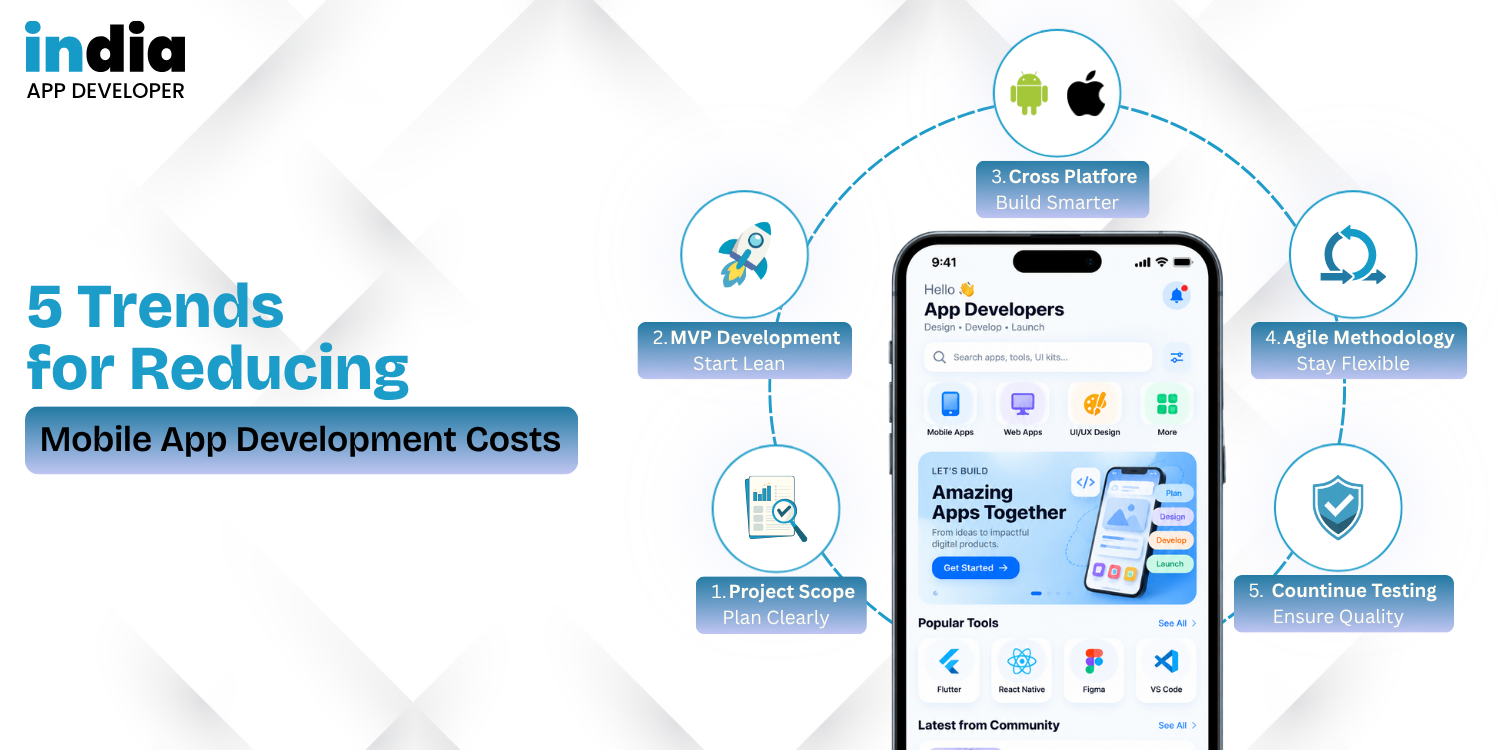
Here are the top 5 trends for cost-effective mobile app development
1. Clearly Defining the Project Scope Before Development
An app development project with poorly defined scope at the beginning is most likely to become an expensive one. Many app development cost escalations happen because the original requirements and project scope were unclear. There are multiple changes in requirement with new features being added every time.
This means the mobile app development company in India working on the project has to repeatedly make changes, which adds to the efforts, time, and ultimately overruns happen. All the major aspects of the app development project need to be chalked out. This should become a roadmap for the entire project.
A meticulous, clearly defined app development project scope should include the following:
- Business goals
- Target audience
- Core app features
- Technology stack
- Platform choice
- User stories
- Third-party integrations
- UI/UX design expectations
- Development milestones
- Risk identification
- Data protection and security
- Testing requirements
- Launch requirements
Based on these, a blueprint should be mapped out so that everyone associated with the project is aware of how the end product will be and what needs to be done to get there. A clearly defined project scope and proper documentation right at the start helps prevent unnecessary efforts and expensive roadblocks at the later stage during the project.
For example, Instead of saying “We need to build a restaurant booking app”, businesses should define whether users can choose time slots, make payments, make reservations, cancel bookings, receive notifications, share reviews and ratings, and view their booking history.
2. Focus on Minimum Viable Product (Mvp) Development
Another effective way to control mobile app development cost is to build a Minimum Viable Product or MVP.
Instead of going for full feature-rich mobile app development, businesses should first focus only on the core functionalities that solves the primary user problem. Businesses can begin with a smaller product having basic features instead of trying to launch the full version of the product right at the start.
Launching an MVP enables businesses and brands to test their idea with real market demand, collect user feedback, and understand expectations before investing heavily in full-scale app development with advanced features.
For example, an online grocery app in India may not require AI product recommendations, subscription management, advanced analytics, voice search, or multiple payment methods from Day 1. The initial version could only focus on product browsing, cart management, payments, placing orders, and order tracking.
The MVP approach reduces financial risks and prevents unnecessary efforts and spending on features which users may not require at present. Once the users start using the apps, businesses can gradually add new features which are really useful.
This approach allows businesses to test an idea in the market without committing a large budget at the beginning.
Ideation → Basic features → MVP → User feedback → Enhancements → Full scale app development
3. Choosing the Right Development Approach
Creating separate native apps for Android and iOS is expensive for brands. This is because native app development increases the effort and development time required as each platform may need separate implementation and testing.
Selecting the right development approach involves choosing between iOS, Android, or cross-platform development. Each of them has their own pros and cons. For example, while analyzing the pros and cons of iOS app development, you may find that while it offers a high return of investment (ROI) per user (advantage), the initial cost of development is high (disadvantage) compared to shared codebases.
In a cross-platform development approach, the app development company in India you choose uses technologies such as React Native and Flutter to build applications that can function on both Android and iOS using a shared codebase.
The choice of development approach should be based on your budget, target audience, user expectations and brand requirements.
| Development approach | Cost of app development |
| Android | Ideal when Android is the immediate target market |
| iOS | Suitable when primary target audience is iOS users |
| Native (Android + iOS separately) | Separate implementations require higher efforts, increasing the cost. |
| Cross-platform | Repeated development work can be saved due to code reuse features. |
4. Agile Methodology
Agile development approach breaks the complex app development project into smaller parts, known as sprints. The project can be divided into tasks, subtasks, and modules. These short pieces are easier to handle. Implementing Agile methodology into mobile app development offers benefits such as quick development and budget control. Maintaining the app becomes easy for both the developer and owners when it is converted into small actionable steps.
Agile methodology minimizes unnecessary spending by identifying errors early, facilitating clear and seamless communication, and allows business to focus on features depending on changing requirements. While Agile development, changes can be handled more effectively and rework can be reduced, thus saving valuable time and efforts.
5. Continuous Testing
Similar to building a house, developing a mobile app has many minor things that need to be taken care of. All software has bugs, and mobile apps are no exception to this. No matter at which stage of the mobile app development process they get added in, fixing them requires money. It is more costlier to fix them during implementation and testing phase than fixing them during the design stage at the start.
Continuous testing helps to offset the costs that arise due to errors made during the app development process. By following a DevOps methodology, continuous testing is the process of testing a mobile app at every stage of development lifecycle. The objective of continuous testing is to assess the quality of the app to ensure that the errors are identified and fixed as early as possible.
After publishing a mobile app, continuous testing is vital. It is important to identify and fix bugs to make the app as smooth and hassle-free as you can for all the users. If the UI of the app is not user-friendly, then the developer needs to upgrade the app. This upgrade of the mobile app increases the total cost for the business. Hence, regular testing is crucial to reduce the total mobile app development cost.
A Practical Approach for Businesses to Reduce Mobile App Development Cost
Here is a practical approach to how businesses can build a cost-effective mobile app.
| Define the business objectives | Clearly identify the problem of users that mobile apps are going to solve. |
| Identify the target audience | Understand who the app users are going to be and what they expect from it. |
| Classify feature | Sort features into ‘must-haves’ and ‘additional’ that can be introduced later. |
| Build an MVP | Launch an MVP with core features instead of waiting to include everything. |
| Gather feedback | Test the app with real users in the market, collect feedback, and spot the areas for improvement. |
| Gradually add features | Add features gradually to the app based on user feedback and business performance. |
Reducing mobile app development cost is not about hiring an app development company that offers services for cheap and compromises on the quality of the mobile app. It is all about making smarter decisions at every stage of the mobile app development lifecycle. Working with a professional and expert mobile app development company India is the best decision that businesses can make.
With the right development partner by your side, the entire project can be kept aligned with your business objectives and budget. Businesses should focus on building what the users need first, utilize resources intelligently and efficiently, and scale the app as the business grows.
Cost effective mobile app development is not just about cutting costs to build less. It is about creating an app that delivers meaningful value for a business by making the best use of time, resources, technology, and investment.
Indiaappdeveloper as a Trusted Partner for Cost-Effective Mobile App Development
A clearly defined strategy is crucial in reducing unnecessary and additional expenses when it comes to mobile app development. A professional mobile app development company in India can help you in building top-notch solutions at affordable rates. IndiaAppDeveloper can be a perfect choice. We are a reputed mobile app development company with 13+ years of experience in providing exceptional, cost-effective, and result-oriented mobile app development solutions for startups, SMEs and emerging businesses.
As a reliable app development company, we help brands build secure and scalable digital solutions aligned with their long-term growth objectives. You can hire dedicated developers in India remotely for your business with flexible hiring models for short and long-term projects. Our team has helped multiple businesses embark on their digital transformation journey with world-class mobile apps.
Reduce mobile app development costs and get the best app development solutions at competitive prices from IndiaAppDeveloper. Get in touch with our team and explore various options for collaboration. Learn how we can transform your business.
FAQs
I am planning to build a mobile app. How can I reduce the mobile app development cost without compromising on the quality?
If you have a limited budget or want to reduce the cost of mobile app development without affecting the quality, focus on limited features built properly rather than several features included in the app. Do not compromise on the architecture, quality assurance, and security of the app.
Which factors should I take into consideration before choosing a mobile app development company in India?
If you are planning to hire dedicated developers in India or an app development company, you should take into consideration the following factors:
- Expertise and experience
- Portfolio
- Client testimonials and success stories
- Transparency and pricing
- Code ownership and intellectual property
- Post-deployment support and maintenance
How much does MVP cost compared to a complete mobile app with all features?
A MVP costs 40-50 percent less than a mobile app with full features depending on several factors.
What hidden charges should I plan for in mobile app development?
When it comes to mobile app development cost, you should take into consideration the following hidden charges:
- App store publishing fees
- Backend hosting
- Push notification services
- Third-party API subscriptions
- Analytics tools
- Annual maintenance
Does outsourcing reduce the mobile app development cost?
Definitely. Outsourcing your project to a professional mobile app development company in India can reduce the overall cost and result in a savings of about 40-50 percent. You do not have to worry about infrastructure costs and overhead expenses.